About our Patron
|
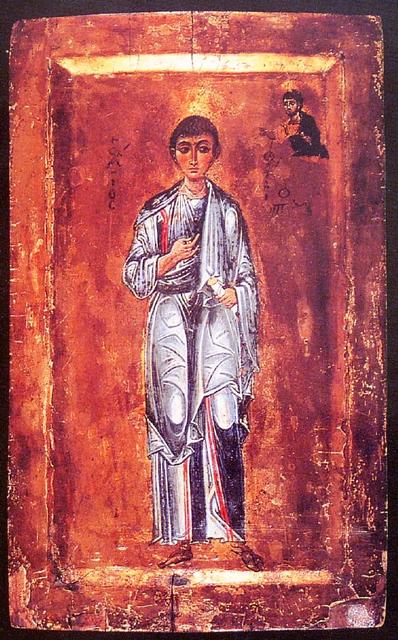
Apostle Philip - St Catherine Monastery, Sinai |
Holy Apostle Philip
Troparion in Tone 3
O Holy Apostle Philip,
intercede with our merciful God
to grant our souls forgiveness of sins.
O Holy Apostle Philip,
intercede with our merciful God
to grant our souls forgiveness of sins.
Listed as one of the Twelve Apostles (Acts 1:13, Matthew 10:1-4, Mark 3:13-19, Luke 6:12-16), the Holy Apostle Philip hailed from Bethsaida, as did both Andrew and Peter (John 1:44). Being a model of obedience, Philip followed immediately when Christ beckoned, "Follow Me" (John 1:43).
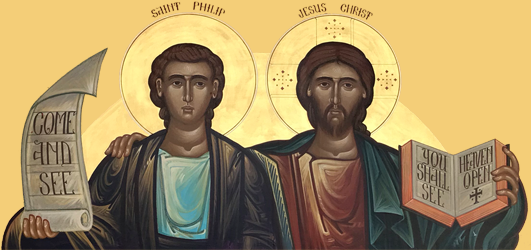
Philip is also an excellent example of personal evangelism, once having chosen to follow Christ, he found Nathanael and said, "We have found Him whom Moses in the law, and also the prophets, wrote - Jesus of Nazareth, the son of Joseph." When Nathanael derided his message with, "Can anything good come from Nazareth?" Philip responded, "Come and see" (John 1:45-46).*
Philip seems to have been practically minded. When present at the Feeding of the Five Thousand, he observed upon Christ's test that, "Two hundred denarii worth of bread is not sufficient for them, that every one of them may have a little" (John 6:5-7). At the Passover Meal and the Institution of the Eucharist, after the Washing of the Feet and Christ's declaration that He Himself is the way to the Father, Philip is the one who made the seemingly straightforward request, "Lord, show us the Father, and it is sufficient for us" (John 14:8). In both cases, Christ our Savior moved Philip and the others beyond their materialistic understanding: first, in the miraculous Feeding of the Five Thousand; and second, in the proclamation, "He who has seen Me has seen the Father;" and "Believe Me that I am in the Father and the Father in Me ..." (John 14:9,11).
Philip, however, must have been quite approachable. On Palm Sunday, when certain pious Greeks would see Jesus, they approached Philip, asking, "Sir, we wish to see Jesus" (John 12:21). He was also blessed with faithfulness, for he was presumably numbered among the Ten Disciples when Christ appeared after His Resurrection (John 20:19-23). He was also present in the Upper Room after the Ascension of Christ and at the Descent of the Holy Spirit (Acts 1:13).
The later career of the Holy Apostle Philip is less well documented. The Church Historian, Eusebius, cites Polycrates, Bishop of Ephesus (later 2nd century), as a source and preserves some of his references to the Holy Apostle in his Ecclesiastical History. Polycrates, who was the leading Quartodeciman of Asia at the time, placed the Holy Apostle in Asia (modern Turkey), recording that he died and lay buried in Hierapolis. Other traditions add that he died a martyr's death by crucifixion. Later hagiographical legends report him as evangelizing as far afield as northern France. Polycrates also reports that the Holy Apostle was a family man with three daughters, two of whom were buried in Hierapolis while the third rested in Ephesus.
His memory is celebrated by the faithful on 14 November. His troparion is quoted above. May all faithful Orthodox Christians benefit by his glorious examples of obedience, faithfulness, approachability, and personal evangelism. May Christ our God bless us and save us through the prayers of the Holy Apostle Philip.
Synaxarion from the Horologion of Holy Transfiguration Monastery
This Apostle, one of the Twelve, was from Bethsaida of Galilee, and was a compatriot of Andrew and Peter. He was instructed in the teachings of the Law, and devoted himself to the study of the prophetic books. Therefore, when the Lord Jesus called him to the dignity of apostleship, he immediately sought out and found Nathanael and said to him, "We have found Him of Whom Moses in the Law and the Prophets did write, Jesus of Nazareth, the son of Joseph" (John 1.45). Having preached Jesus the God-man throughout many parts of Asia Minor, and having suffered many things for His Name's sake, he was finally crucified upside down in Hierapolis of Phrygia.
____________________________
* This compelling invitation graces the icon at the main entrance of our church.
Philip is also an excellent example of personal evangelism, once having chosen to follow Christ, he found Nathanael and said, "We have found Him whom Moses in the law, and also the prophets, wrote - Jesus of Nazareth, the son of Joseph." When Nathanael derided his message with, "Can anything good come from Nazareth?" Philip responded, "Come and see" (John 1:45-46).*
Philip seems to have been practically minded. When present at the Feeding of the Five Thousand, he observed upon Christ's test that, "Two hundred denarii worth of bread is not sufficient for them, that every one of them may have a little" (John 6:5-7). At the Passover Meal and the Institution of the Eucharist, after the Washing of the Feet and Christ's declaration that He Himself is the way to the Father, Philip is the one who made the seemingly straightforward request, "Lord, show us the Father, and it is sufficient for us" (John 14:8). In both cases, Christ our Savior moved Philip and the others beyond their materialistic understanding: first, in the miraculous Feeding of the Five Thousand; and second, in the proclamation, "He who has seen Me has seen the Father;" and "Believe Me that I am in the Father and the Father in Me ..." (John 14:9,11).
Philip, however, must have been quite approachable. On Palm Sunday, when certain pious Greeks would see Jesus, they approached Philip, asking, "Sir, we wish to see Jesus" (John 12:21). He was also blessed with faithfulness, for he was presumably numbered among the Ten Disciples when Christ appeared after His Resurrection (John 20:19-23). He was also present in the Upper Room after the Ascension of Christ and at the Descent of the Holy Spirit (Acts 1:13).
The later career of the Holy Apostle Philip is less well documented. The Church Historian, Eusebius, cites Polycrates, Bishop of Ephesus (later 2nd century), as a source and preserves some of his references to the Holy Apostle in his Ecclesiastical History. Polycrates, who was the leading Quartodeciman of Asia at the time, placed the Holy Apostle in Asia (modern Turkey), recording that he died and lay buried in Hierapolis. Other traditions add that he died a martyr's death by crucifixion. Later hagiographical legends report him as evangelizing as far afield as northern France. Polycrates also reports that the Holy Apostle was a family man with three daughters, two of whom were buried in Hierapolis while the third rested in Ephesus.
His memory is celebrated by the faithful on 14 November. His troparion is quoted above. May all faithful Orthodox Christians benefit by his glorious examples of obedience, faithfulness, approachability, and personal evangelism. May Christ our God bless us and save us through the prayers of the Holy Apostle Philip.
Synaxarion from the Horologion of Holy Transfiguration Monastery
This Apostle, one of the Twelve, was from Bethsaida of Galilee, and was a compatriot of Andrew and Peter. He was instructed in the teachings of the Law, and devoted himself to the study of the prophetic books. Therefore, when the Lord Jesus called him to the dignity of apostleship, he immediately sought out and found Nathanael and said to him, "We have found Him of Whom Moses in the Law and the Prophets did write, Jesus of Nazareth, the son of Joseph" (John 1.45). Having preached Jesus the God-man throughout many parts of Asia Minor, and having suffered many things for His Name's sake, he was finally crucified upside down in Hierapolis of Phrygia.
____________________________
* This compelling invitation graces the icon at the main entrance of our church.
Calendar